)
In Deep:
Ho Chi Minh City (aka Saigon)
Beginning as a small fishing village inhabited primarily by the Khmer people, Ho Chi Minh city, formerly (and still occasionally) known as Saigon, has grown into the largest city in Vietnam.
An Influx of Refugees
The small fishing village known as Prey Nokor was inhabited for centuries by Khmer people before the arrival of the Vietnamese. The original Vietnamese settlers were refugees fleeing south into the Mekong during the Trinh-Nguyen civil war in Vietnam in 1623. Gradually, increasing waves of Vietnamese settlers began taking over the region, and the Cambodian kingdom, in a weakened state from their war with Thailand, was rendered powerless to intervene in the settlement of the area by the Vietnamese.
Becoming Sai Gon
In 1698, Nguyễn Hữu Cảnh, a Vietnamese noble, was sent by the Nguyen rulers of Hue to establish Vietnamese administrative structures in the area, thus officially claiming the area from Cambodia, and Prey Nokor became known as Sai Gon.
“Paris in the Orient”
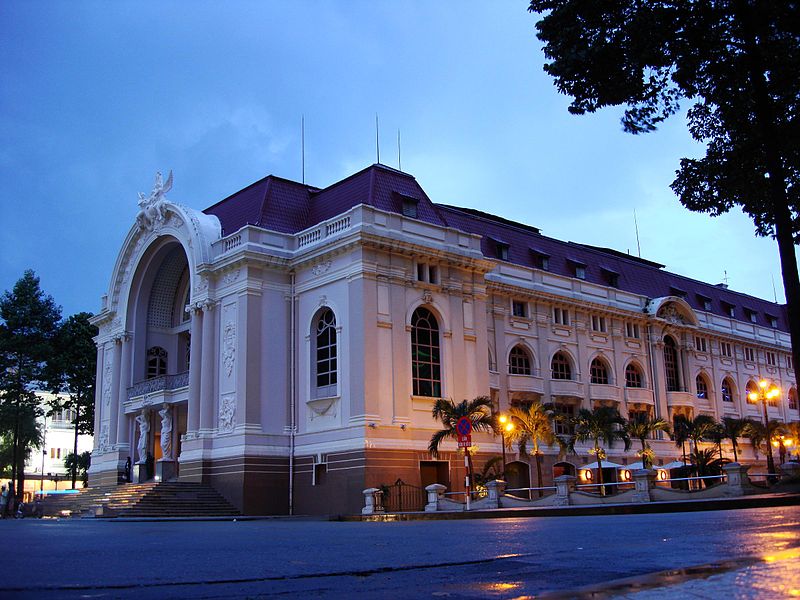
However, Vietnamese power over the city was relinquished to the French in 1859; Saigon was occupied and made capital of the French colony of Cochinchina. The city began to expand and develop under French influence and a number of colonial-style buildings were constructed, as Saigon became referred to as “Paris in the Orient.” After the end of the Second World War, Saigon remained the capital of the French colony of Cochinchina.
See for Yourself
From Hanoi to Ho Chi Minh City, Vietnam is a contrast of distinctly local cultures—and on our Vietnam Biking trip, you’ll find yourself immersed in each of them.
DETAILED ITINERARYAfter the Vietnam War
Later, from 1954 to 1975, Saigon was the capital of the independent state of South Vietnam. At the conclusion of the Vietnam War, on April 30, 1975, the city came under the control of the Vietnamese People’s Army, and in 1976, upon the establishment of the unified communist Socialist Republic of Vietnam, the city of Saigon was renamed Ho Chí Minh City in honour of the late communist leader Ho Chí Minh. The former name Saigon is still widely used by many Vietnamese, especially in informal contexts, and the word “Saigon” can also be found on shop signs all over the country, even in Hanoi. (It’s also worth noting that one of the city’s boroughs, District 1, is still named Saigon. Often the entire city will be referred to as Saigon when speaking of this district, much as the name New York is often used when people refer to Manhattan.)
The Man Himself: Ho Chi Minh (1890-1969)
Born in 1890, Ho Chí Minh spent more than 30 years of his life outside of Vietnam. He spent time working in New York and studying in Moscow and Paris, giving him an intimate understanding of both the Americans and the French. Perhaps this is why he was able to defeat both. His communist activities began early on with his studies of Marxism after the end of the First World War. Not only was he the founder of the Viet Minh (Vietnamese Communist Party), he was also a founding member of the French Communist Party in Paris. In 1925, he established the Vietnamese Revolutionary Youth League in Canton, China, thereby beginning his long struggle for Vietnamese independence. Twenty years later, Ho Chí Minh declared the independence of the Republic of Vietnam in Ba Dinh Square shortly after the defeat of the Japanese forces in China. Ironically, he based his famous speech on the American Declaration of Independence.
The French surrendered to the Viet Minh after the battle of Dien Bien Phu on May 7, 1954, thereby ending French Colonial rule. The Geneva Accords were signed in 1956, dividing the country into the North and the South at the 17th parallel. The Americans were determined not to allow the South to fall to Ho’s communist forces. Ho died in 1969, so when Saigon fell to the Viet Cong in 1975, he was not there to see his dream of a unified Vietnam come true. His body was preserved by the same doctor who worked on both Lenin in Moscow and Mao in Beijing. Ho lies in state in a glass case within the Mausoleum in Hanoi, which is open for visitation in the mornings only.
MORE FROM Asia-Pacific + Vietnam

Biking in Cambodia with B&R Expert Guide Fin
Cambodia
The Slow Fund: Rice Production with Ozuchi Village
Japan
Take a Virtual Ride on the Hai Van Pass in Vietnam
Vietnam
How Three Cambodian Hotels Are Joining Forces to Feed Their Communities
Cambodia
Meet Fin—B&R’s Expert Guide in Cambodia
Cambodia
An Insider’s Eye on Vietnam: What to See and What to Skip, According to our Vietnam Expert
Vietnam
Photo Essay: Exulting in Mongolia’s Eternal Blue Sky
Mongolia
The Best Times of Year to Travel to Asia
Vietnam
Chris Litt: On Mongolia and the Desire to Disconnect
Mongolia
Top 6 Multi-Day Walks in Australia
Australia
The 8 Best Restaurants in Auckland
New Zealand
The 5 Best Restaurants in Wellington
New Zealand
8 Reasons Why You Need to Take an Australian Adventure
Australia
Cultural Quirks About Bhutan That Will Blow Your Mind
Bhutan
5 Things to Know Before You Go to Japan
Japan
8 Favourite Restaurants to Eat in Queenstown
New Zealand
10 Must-Try Australian Wines
Australia
Where to Eat in Hong Kong: 7 Best Restaurants
China
A Kiwi’s Guide to Enjoying New Zealand
New Zealand